
2026 CONSUMER SAFETY GUIDE
Learn how to recognize authentic customer feedback, identify suspicious
testimonials and evaluate online reputation before making decisions.
experiences of other customers before choosing a product, website,
business or service. Online feedback can reveal useful information about
quality, reliability, communication and customer support. However, not
every review published on the internet represents a real customer
experience.
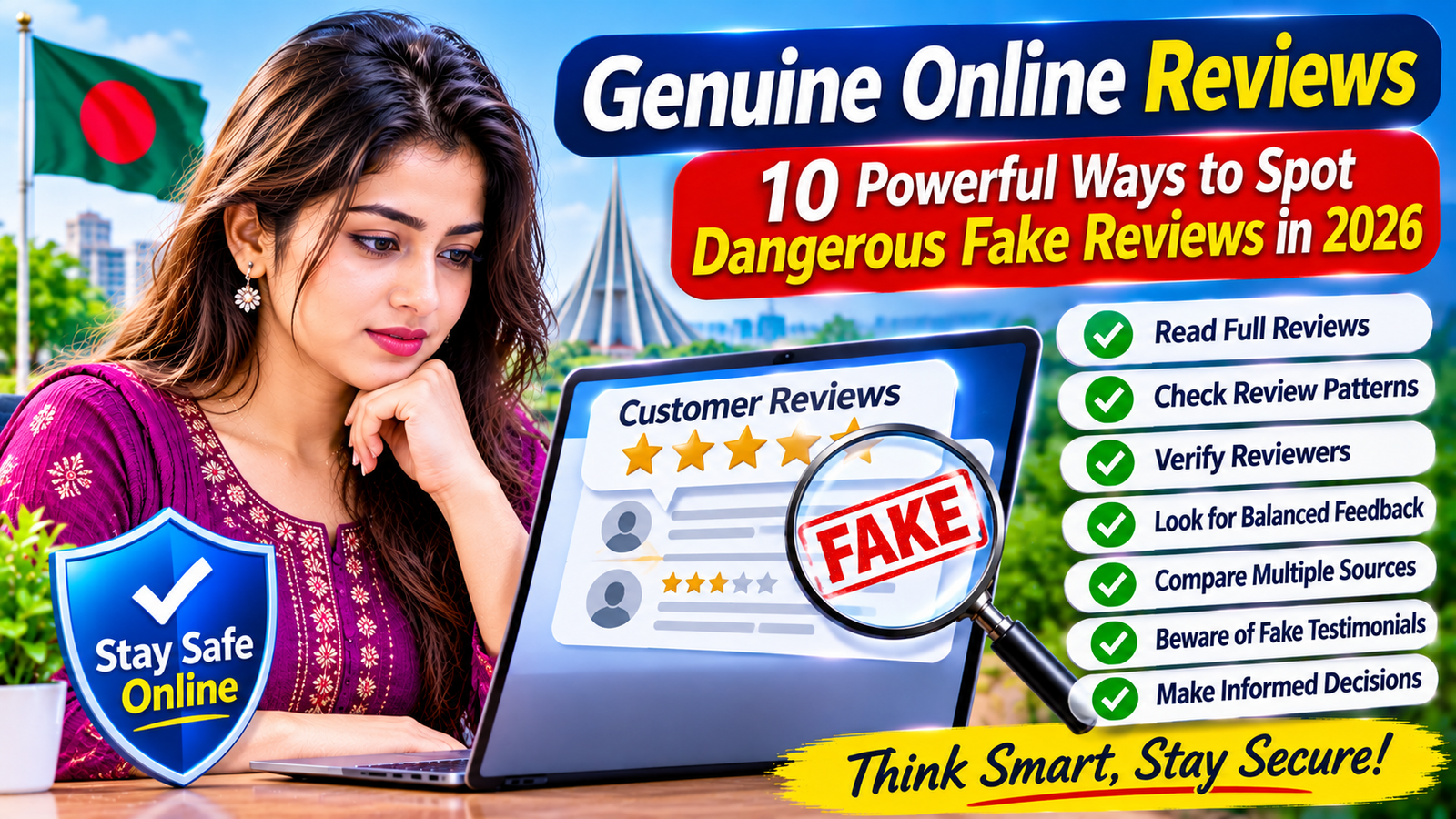
Fake testimonials, paid ratings, copied comments and misleading feedback
can influence purchasing decisions. Some reviews are written to make a
business appear more trustworthy than it really is, while others may be
published to damage a competitor’s reputation.
This Genuine Online Reviews guide explains ten practical ways to evaluate
customer feedback, identify warning signs and make more informed online
decisions. Whether you are researching a local business in Bangladesh
or comparing an international website, learning to assess reviews is an
important digital safety habit.
Why Genuine Online Reviews Matter
Online reviews can provide useful insights that may not appear in
advertisements or promotional descriptions. Customers often discuss
their experiences with product quality, delivery, communication,
website usability and after-sales support.
However, reviews should be treated as one source of information rather
than absolute proof. A high rating does not automatically guarantee
quality, and a negative comment does not necessarily mean a business
is unreliable.
The most responsible approach is to compare multiple sources, examine
review details and look for consistent patterns over time.
1. Read the Full Review, Not Just the Star Rating
One of the easiest mistakes is judging a business only by its average
star rating. A five-star score may look impressive, but the written
feedback provides more context about the customer’s actual experience.
Read several reviews and look for specific details. Authentic feedback
may describe what the customer expected, what happened and which parts
of the experience were satisfactory or disappointing.
What to Look for in Review Content
- Specific descriptions of the customer’s experience.
- Clear explanations rather than repeated promotional phrases.
- Relevant details about the product or service.
- Reasonable comments about both strengths and weaknesses.
- Information that helps readers understand the context.
Very short reviews are not automatically fake. Some genuine customers
simply prefer writing brief comments. The important point is to evaluate
the overall pattern instead of making a decision based on one sentence.
2. Look for Repeated Review Patterns
Repeated wording can be a warning sign when many reviews appear to have
been written using the same template. Artificial review campaigns may
use similar phrases, sentence structures or promotional language.
Possible Warning Signs
- Multiple reviews use nearly identical wording.
- Several comments repeat the same unusual phrases.
- Many reviews contain generic praise without useful details.
- Different accounts appear to publish similar messages.
- Review language seems unrelated to the actual business.
Similar wording alone does not prove that reviews are fake. Customers
may naturally use common expressions. Look for several warning signs
together before drawing conclusions.
3. Check Review Dates and Publishing Timing
Review timing can reveal useful information about how feedback develops.
A business that receives reviews consistently over a long period may
show a different pattern from one that suddenly receives dozens of
highly similar comments within a very short time.
Review Timing Questions
- Were many reviews published on the same day?
- Did a sudden rating increase happen without explanation?
- Are there genuine-looking reviews from different months?
- Does the feedback show a consistent history?
A sudden increase in reviews is not proof of manipulation. A business
may have recently completed a successful campaign or received attention
from a large audience. Check additional evidence before making a
judgment.
4. Examine Reviewer Profiles Carefully
Some review platforms allow users to view public reviewer profiles.
These profiles may provide additional context about a person’s
contribution history.
A profile with a varied history of reviews across different places or
products may provide more context than an account that publishes only
repetitive promotional comments.
Profile Details Worth Reviewing
- Whether the account has a history of varied feedback.
- Whether reviews contain useful and relevant details.
- Whether multiple profiles appear unusually similar.
- Whether the profile activity looks consistent over time.
Be careful not to judge people unfairly. New accounts, limited review
histories and anonymous profiles do not automatically indicate fraud.
Review profiles should be considered alongside other available evidence.
5. Look for Balanced and Detailed Customer Feedback
Real experiences are not always perfect. A customer may appreciate
certain aspects of a product while identifying areas that need
improvement. Balanced comments can therefore provide valuable context.
For example, a detailed review might explain that a product arrived
safely but its packaging could be improved. Another customer might
appreciate responsive support while mentioning a delay.
Why Balanced Feedback Is Useful
- It provides more context than generic praise.
- It helps readers understand possible limitations.
- It gives businesses useful improvement suggestions.
- It helps compare different customer experiences.
Remember that a genuine customer can have a completely positive or
negative experience. Balanced feedback is useful, but it is not a
requirement for authenticity.
6. Evaluate How Businesses Respond to Reviews
A business’s response to customer feedback can reveal how it approaches
communication and problem-solving. Responsible organizations often
acknowledge concerns, provide relevant explanations and communicate
respectfully.
Signs of Responsible Review Management
- Responses address the actual concern.
- Staff communicate respectfully.
- Public replies avoid revealing private customer information.
- Businesses explain how customers can seek further assistance.
- Responses remain professional during disagreements.
A business does not need to agree with every review. However, aggressive
replies, personal attacks or requests to publish private information
should make readers cautious.
Businesses and customers should avoid sharing telephone numbers,
addresses, identification documents or private conversations in public
review responses.
7. Compare Reviews Across Independent Sources
Relying on one review platform can create an incomplete picture. Different
websites may have different moderation policies, user communities and
review collection methods.
Comparing independent sources can help you understand whether the same
strengths or concerns appear consistently.
Useful Sources to Compare
- Independent consumer review platforms.
- Official product documentation.
- Verified marketplace feedback where available.
- Relevant industry publications.
- Public customer support and policy information.
Do not assume that every website displaying reviews uses the same
verification standards. Check how each platform collects, moderates
and displays customer feedback.
You can also review a website’s published
terms and policies
to understand its stated approach to website information and user
communication.
8. Understand Paid, Sponsored and Incentivized Reviews
Some reviewers receive free products, discounts, rewards or other
benefits in exchange for sharing feedback. This does not automatically
make their opinions false, but the relationship should be clearly
disclosed.
Readers need to understand whether a review represents an independent
customer opinion or feedback influenced by a commercial relationship.
Questions to Ask
- Does the reviewer disclose receiving a free product?
- Is the review sponsored or commercially connected?
- Does the platform explain its review policies?
- Can the reader distinguish advertising from independent feedback?
Transparency helps readers evaluate the context behind a testimonial.
If a commercial relationship is unclear, look for additional independent
information before relying on the review.
For consumer protection information, visit
FTC Consumer Advice
.
9. Use Trusted Review Platforms Carefully
Review platforms can help users compare experiences, but no platform
should be treated as a perfect source of truth. Moderation systems,
verification methods and review policies can differ significantly.
Before relying on a platform, understand how it handles suspicious
reviews, conflicts of interest, reported content and customer complaints.
Platform Safety Tips
- Read the platform’s review and moderation policies.
- Check whether verified-purchase labels are available.
- Understand what verification labels actually mean.
- Be cautious of websites that hide important business information.
- Do not share passwords or financial details to submit a review.
For general online security guidance, explore
CISA Secure Our World
and
National Cybersecurity Alliance
.
10. Make Informed Decisions Using Genuine Online Reviews
Reviews are most useful when they are considered together with other
evidence. A high rating should not replace checking product details,
business information, privacy policies or payment conditions.
A Practical Decision-Making Process
- Identify what information you need before making a decision.
- Read a reasonable number of recent reviews.
- Compare positive, negative and neutral feedback.
- Look for repeated patterns or unusual review activity.
- Check independent sources for additional information.
- Review the website’s policies and contact information.
- Avoid making rushed decisions based on pressure or promotional claims.
This approach helps reduce the influence of misleading testimonials and
supports more responsible online research.
Genuine Online Reviews: Quick Verification Checklist
Before relying on an online review, use this checklist to evaluate its
credibility and relevance.
Review Credibility Checklist
- Read the full review instead of relying only on its rating.
- Check whether the feedback contains relevant details.
- Look for repeated wording across multiple comments.
- Review publishing dates and unusual activity patterns.
- Consider the reviewer’s public contribution history.
- Look for clear sponsorship or incentive disclosures.
- Compare information across independent sources.
- Review the business’s public response to criticism.
- Check website policies and available business information.
- Make decisions based on multiple sources of evidence.
Online Trust, Transparency and Responsible Communication
Genuine customer feedback is only one part of a trustworthy online
environment. Clear policies, responsible communication and respect
for personal privacy are equally important.
When reviewing any website, take time to understand how it presents
information and handles user privacy. You can explore the
Gulshan Escort website
and its published
frequently asked questions
for examples of website information and user-facing policies.
For more general educational material, visit the
website blog
.
Always evaluate information independently and avoid treating
promotional statements as verified customer experiences.
Frequently Asked Questions About Genuine Online Reviews
1. What are Genuine Online Reviews?
Genuine Online Reviews are customer feedback that honestly represents
a person’s experience with a product, website, business or service.
They provide useful information without deliberately misleading
readers.
2. How can I identify a fake online review?
Look for repeated wording, unusual publishing patterns, unsupported
promotional claims and inconsistencies. Consider multiple warning
signs rather than relying on one detail.
3. Are five-star reviews always trustworthy?
No. A five-star rating alone does not prove authenticity. Read the
written feedback, check review patterns and compare independent
sources.
4. Can a negative review be fake?
Yes. False negative reviews may be used to damage a business’s
reputation. Evaluate the details and look for supporting evidence
before accepting a claim.
5. Are incentivized reviews always fake?
No. A reviewer may receive a benefit and still provide an honest
opinion. Clear disclosure is important so readers understand the
commercial relationship.
6. Why should I compare reviews from different websites?
Independent sources can provide different perspectives and help
reveal whether similar experiences appear consistently across
multiple platforms.
7. What should a business do about fake reviews?
A business can preserve relevant evidence, report suspicious feedback
through the platform’s official process and respond professionally
without exposing private customer information.
8. Should I trust reviews from social media?
Social media feedback can provide useful context, but verify important
claims through independent sources. Be especially cautious of
anonymous promotional posts and suspicious links.
9. Do verified-purchase labels guarantee honest reviews?
No. A verified-purchase label may indicate a purchase relationship
under a platform’s rules, but it does not guarantee that every
statement in the review is accurate.
10. What is the safest way to use online reviews?
Read detailed feedback, compare different sources, check website
information and avoid rushed decisions based on ratings or
promotional claims alone.
Final Thoughts: Choose Information You Can Verify
Understanding Genuine Online Reviews is an important
part of responsible internet use. Customer feedback can help people
evaluate products and websites, but it should never be the only factor
behind an important decision.
By checking review details, identifying unusual patterns, comparing
independent sources and understanding sponsored feedback, you can make
more informed choices.
Take your time, verify important information and remember that online
trust should be supported by transparency and evidence rather than
ratings alone.
© 2026 Genuine Online Reviews. All rights reserved.
Make informed decisions through responsible online research.