
2026 ONLINE SAFETY EDITION
A practical guide to protecting your personal information, online accounts,
digital identity and privacy while using the internet in Bangladesh.
for anyone who uses smartphones, social media, websites, email, online
banking or digital communication platforms. As internet use continues to
grow, people need to understand how to protect their personal information
and recognize common online threats.
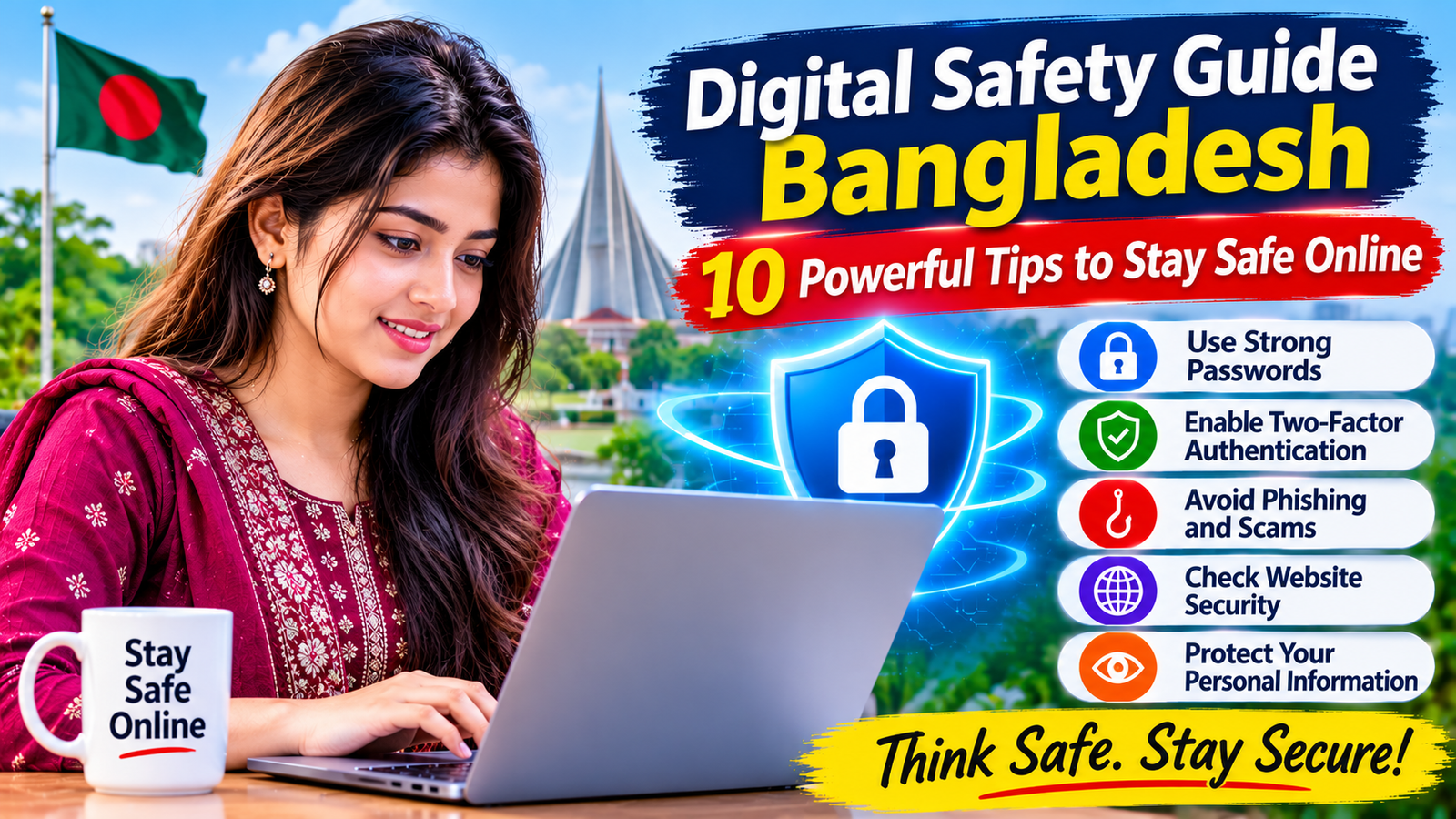
Digital safety is not only about installing antivirus software. It also
involves using strong passwords, recognizing suspicious messages,
checking website credibility, protecting private photographs and
understanding how personal information can be misused.
Whether you are a student, professional, business owner, local resident
or international visitor, developing safe online habits can reduce your
exposure to phishing, identity theft, impersonation and financial fraud.
This guide explains ten practical steps that can help you make informed
decisions online.
Why Digital Safety Matters in Bangladesh
Digital platforms make communication, education, shopping and business
more convenient. However, every online activity may involve sharing
information with websites, applications or other people.
A publicly visible telephone number, reused password, unsecured social
media account or suspicious website can create privacy risks. Sometimes,
users share personal information without understanding where it may be
stored or how it could be used.
A reliable Digital Safety Guide Bangladesh should therefore explain
practical protection methods rather than simply listing technical terms.
The following recommendations are designed to help everyday internet
users develop better digital habits.
1. Use Strong and Unique Passwords
Password protection is one of the most important parts of digital
security. A weak or reused password can make multiple accounts vulnerable
if one website experiences a data breach.
How to Create a Strong Password
- Use a long password or passphrase.
- Combine different types of characters when appropriate.
- Avoid birthdays, names and predictable number sequences.
- Never reuse the same password across important accounts.
- Consider using a reputable password manager.
Your email account deserves particular attention because it may be used
to reset passwords for other services. Protect it with a unique password
and additional authentication.
Do not share passwords through social media messages, email or
unverified websites. If you suspect that a password has been exposed,
change it immediately and review the account’s recent activity.
2. Enable Two-Factor Authentication for Better Digital Safety
Two-factor authentication, commonly known as 2FA, adds another security
layer to an online account. Instead of relying only on a password, the
account may request an additional verification step.
Common Authentication Methods
- Authenticator applications.
- Security keys.
- Passkeys supported by the platform.
- SMS verification where stronger options are unavailable.
Whenever possible, choose a strong authentication method supported by
the service. Keep recovery codes in a secure location and never share
verification codes with strangers.
A person claiming to be a bank employee, platform representative or
technical support agent should never need your password or one-time
verification code.
3. Recognize Phishing and Online Scams
Phishing is a common online attack in which criminals attempt to trick
users into revealing passwords, financial information or other private
details. These messages may arrive through email, SMS, social media or
messaging applications.
Warning Signs of a Suspicious Message
- A message creates unnecessary urgency or fear.
- A sender asks for passwords or verification codes.
- A link leads to an unfamiliar or misleading website.
- An offer sounds unrealistic or unusually generous.
- A message contains unexpected attachments.
- The sender’s identity cannot be independently verified.
Avoid clicking unexpected links. Instead, open the official website or
application directly and check whether the message is genuine.
You can also use
Google Safe Browsing
to check certain websites for known unsafe content.
4. Check Website Security Before Sharing Information
Not every website is trustworthy. A professional-looking design,
attractive offer or HTTPS symbol does not automatically prove that a
website is legitimate.
What to Check Before Using a Website
- Check the domain name carefully for spelling mistakes.
- Look for clear privacy and contact information.
- Read the website’s terms and policies.
- Be cautious of unexpected downloads and pop-ups.
- Review independent information about the organization.
- Avoid sharing sensitive data without a clear reason.
HTTPS helps protect information transmitted between your browser and a
website, but it does not guarantee that the website owner is honest.
Always review the website’s identity and reputation.
Learn More About Website Credibility
Review our
terms and policies
to understand why transparent website information, privacy rules and
responsible digital communication matter.
5. Protect Your Personal Information Online
Personal information can include your full name, telephone number,
email address, home address, photographs, identification details and
financial information. Sharing too much information publicly can
increase the risk of identity misuse.
Practical Personal Data Protection Tips
- Share only the information necessary for a specific purpose.
- Avoid publishing your home address publicly.
- Do not upload identity documents to unknown websites.
- Review application permissions regularly.
- Remove unnecessary personal details from public profiles.
- Be careful when sharing photographs containing location details.
Before submitting personal information, consider who will receive it,
why it is needed and whether the platform explains how it will be used.
Responsible websites should provide understandable privacy information.
Visitors should take time to read relevant policies before sharing
sensitive details.
7. Be Careful When Using Public Wi-Fi
Public Wi-Fi is convenient in hotels, restaurants, airports, shopping
centres and other shared spaces. However, users should not automatically
assume that every available network is genuine or secure.
How to Use Public Wi-Fi More Safely
- Confirm the correct network name with the venue.
- Avoid sensitive transactions on unfamiliar networks.
- Turn off automatic Wi-Fi connection when unnecessary.
- Keep file sharing disabled on public networks.
- Use trusted websites and applications.
- Disconnect when you have finished using the network.
A VPN from a reputable provider can add protection in some situations,
but it does not make every online activity completely secure. Continue
using HTTPS websites and strong account authentication.
8. Keep Your Devices and Applications Updated
Smartphones, computers and applications may contain security weaknesses.
Software updates often include fixes that help protect devices against
known vulnerabilities.
Device Security Checklist
- Install operating system updates promptly.
- Download applications from official app stores.
- Remove applications that are no longer needed.
- Use a screen lock, PIN or biometric protection.
- Enable automatic security updates where appropriate.
- Back up important files regularly.
Avoid installing unknown applications sent through messaging platforms.
Some unofficial applications may request unnecessary permissions or
contain harmful software.
If an application requests access to your contacts, microphone, camera
or location, consider whether that permission is genuinely required
for its main function.
9. Understand Online Harassment and Identity Impersonation
Online harassment can involve repeated unwanted messages, threats,
intimidation, abusive comments or misuse of personal photographs.
Impersonation happens when someone creates or uses an account that
misleadingly represents another person or organization.
What You Can Do if You Experience Online Harassment
- Do not respond impulsively to threatening messages.
- Save screenshots and relevant account information.
- Record dates, times and message details.
- Block or restrict the account when appropriate.
- Report abusive content through the platform.
- Seek trusted support if you feel unsafe.
Do not edit or delete original evidence if you may need to report an
incident. Keep copies in a secure location and avoid publicly sharing
private information about the person involved.
For additional awareness, read the
website FAQ
and review the available privacy and communication information before
interacting with an unfamiliar online platform.
10. Know What to Do After Online Fraud
If you suspect online fraud, acting quickly can help reduce further
damage. The correct response depends on the type of incident, the
affected account and whether financial information was involved.
Immediate Steps After a Suspected Scam
- Stop communicating with the suspicious person or website.
- Do not send additional money or verification codes.
- Contact your bank or payment provider if financial details were exposed.
- Change compromised passwords from a trusted device.
- Enable additional account security.
- Save messages, receipts, URLs and screenshots.
- Report the incident through appropriate official channels.
If your email or social media account is compromised, review recovery
settings, active sessions and connected applications. Remove unknown
devices and update recovery information.
Where to Find Help
For cybersecurity awareness and relevant guidance, visit
Bangladesh e-GOV CIRT
.
For official police information, visit
Bangladesh Police
.
For consumer fraud education, consult
FTC Consumer Advice
.
Digital Safety Guide Bangladesh: Essential Daily Checklist
Use this simple checklist to review your everyday digital security
habits. Consistency is more important than making a single change and
ignoring it afterward.
Your Online Safety Checklist
- Use unique passwords for important accounts.
- Enable two-factor authentication.
- Check suspicious links before opening them.
- Review privacy settings on social media.
- Keep your phone and computer updated.
- Download applications from trusted sources.
- Avoid sharing sensitive information unnecessarily.
- Review account activity and connected devices.
- Keep backups of important information.
- Know how to report suspicious activity.
Useful Digital Safety Resources for Bangladesh
The following organizations provide information that can help internet
users understand cybersecurity, privacy, fraud prevention and online
safety.
Bangladesh Resources
Bangladesh e-GOV CIRT
– Cybersecurity information and advisories.
Bangladesh Police
– Official police information and public resources.
Bangladesh Laws
– Access to Bangladesh legislation.
International Resources
CISA Secure Our World
– Practical cybersecurity habits.
FTC Consumer Advice
– Consumer protection and scam awareness.
National Cybersecurity Alliance
– Online safety education.
Google Safe Browsing
– Information about unsafe websites.
Responsible Digital Communication and Privacy
Digital safety also depends on how people communicate with one another.
Respecting privacy, personal boundaries and consent helps create a safer
online environment.
Before sharing another person’s photograph, message or personal
information, consider whether you have permission. Avoid forwarding
private conversations or publishing sensitive details without a
legitimate reason.
You can explore the
Gulshan Escort website
and its published
terms and policies
for information about website policies and responsible online
communication.
For additional educational content, visit the
website blog
.
Always review the privacy information of any website before providing
personal details.
Frequently Asked Questions About Digital Safety in Bangladesh
1. What is digital safety?
Digital safety means protecting personal information, devices,
accounts and online activities from unauthorized access, scams,
identity misuse and other digital threats.
2. Why is a Digital Safety Guide Bangladesh important?
A Digital Safety Guide Bangladesh helps internet users understand
common online risks and learn practical ways to protect their
information, privacy and digital accounts.
3. How can I protect my personal information online?
Use strong passwords, enable two-factor authentication, limit public
personal information and share sensitive details only with trusted
services when necessary.
4. How can I recognize a phishing message?
Look for suspicious links, unexpected attachments, urgent demands,
requests for passwords and messages from unverified senders.
5. Is public Wi-Fi safe to use?
Public Wi-Fi can involve security risks. Verify the network name,
avoid sensitive transactions on unfamiliar networks and use secure
websites and applications.
6. What should I do if my social media account is hacked?
Use the platform’s official recovery process, change your password,
review active sessions, remove unfamiliar devices and enable
additional authentication.
7. How can I report online fraud in Bangladesh?
Preserve relevant evidence, contact your financial provider if
necessary and consult appropriate official resources such as
Bangladesh e-GOV CIRT and Bangladesh Police for guidance.
8. Does HTTPS mean a website is completely safe?
No. HTTPS helps encrypt the connection between your browser and a
website, but it does not prove that the website is genuine or
trustworthy.
9. How often should I review my privacy settings?
Review privacy settings regularly and whenever a platform changes
its features, permissions or account security options.
10. What is the easiest way to improve digital safety?
Start with unique passwords, two-factor authentication, regular
software updates and careful handling of suspicious links and
personal information.
Final Thoughts: Build Safer Digital Habits in 2026
Following a practical Digital Safety Guide Bangladesh
can help individuals make more informed decisions while using the
internet. Strong passwords, account authentication, privacy awareness,
website verification and responsible communication are important
foundations of online protection.
No single security measure can eliminate every digital risk. However,
combining several good habits can reduce unnecessary exposure and help
protect your personal information.
Stay informed, think before sharing, verify unfamiliar requests and
use official resources when you need assistance. Digital safety is an
ongoing responsibility, not a one-time task.
© 2026 Digital Safety Guide Bangladesh. All rights reserved.
Use the information responsibly and protect your digital privacy.
6. Improve Social Media Privacy Settings
Social media platforms allow people to connect and communicate, but
public profiles may reveal more information than users intend. Details
such as daily routines, workplace information, travel plans and personal
photographs can create privacy concerns.
Recommended Social Media Safety Habits
Fake accounts may use copied photographs or misleading information.
Do not assume that a familiar profile picture proves someone’s identity.
If you notice a suspicious account using your photographs or personal
details, preserve relevant evidence and use the platform’s official
impersonation-reporting process.
Avoid posting real-time travel locations or publicly announcing when
your home will be empty.